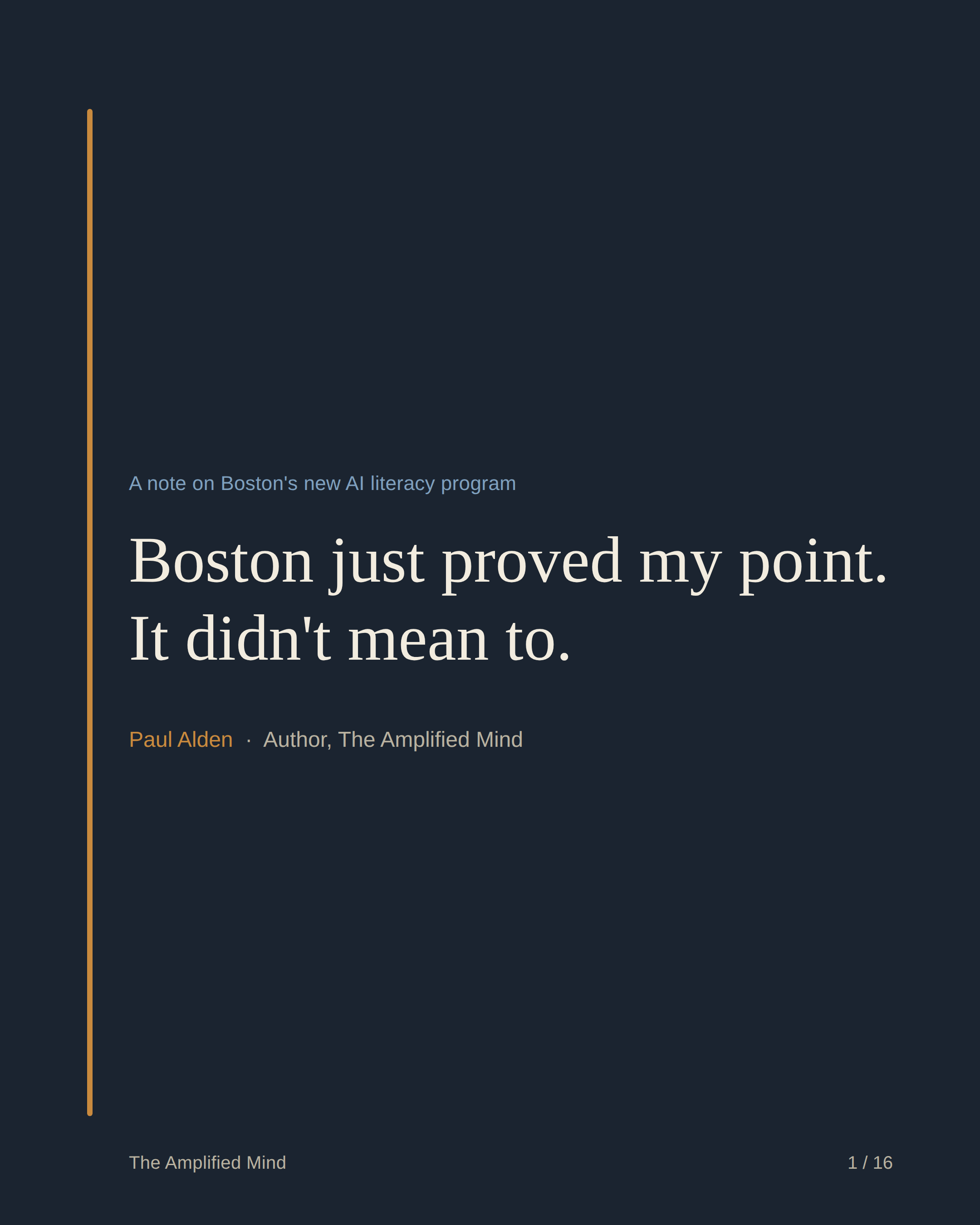

In March, Boston announced it would become the first major U.S. city to guarantee every public high school graduate leaves with AI literacy. Then, within days, two of the outlets covering it had to issue corrections. It wasn’t a graduation requirement after all. It was a goal, a program, a partnership. Not a mandate.
That correction is a small story. But it’s also a perfect, accidental demonstration of the exact problem I wrote The Amplified Mind to name: fluent information moves faster than verified information, and even careful newsrooms can repeat a claim before checking whether it’s true.
If professional journalists can get that wrong on a single, checkable fact, what happens when a sixteen-year-old asks an AI model to summarize a source, and the model sounds just as confident while being wrong?
That’s the verification gap. And it’s about to become curriculum in the city where I live.
What Boston is actually building
Strip away the “graduation requirement” headline and what’s left is still significant. Boston is launching a public-private partnership, funded in part by a $1 million contribution from tech entrepreneur Paul English, to bring AI literacy programming into BPS high schools this fall. Superintendent Mary Skipper has said students will also get access to credit-bearing AI courses through UMass Boston. A new AI Industry Advisory Board, chaired by English and Ellen Rubin, will help shape what gets taught.
The framing from city leaders is worth sitting with. Mayor Michelle Wu described the goal as making sure students have the fluency to make the most of the opportunities in front of them, not simply teaching them to operate a tool. English went further, saying he wants these classes to teach kids how to use AI ethically and responsibly, and, in his words, how to know when it’s hallucinating and when it’s not.
Read that last part again. That’s not a tech literacy goal. That’s a discernment goal. It’s the same distinction I spent fourteen chapters building a case for: the machine generates, the thinker decides. Boston’s own initiative, in its own founder’s words, is describing the thinker’s job, not the machine’s.
The gap between the ambition and the curriculum
Here’s what I don’t yet know, and what I think matters most: I haven’t been able to verify exactly where curriculum development stands right now, beyond reports that teachers would be joining the process over the summer ahead of a fall rollout. Exactly what “knowing when it’s hallucinating” looks like as a taught, assessable skill for a ninth grader isn’t public yet, as far as I can find.
That’s not a criticism. Building a discernment curriculum from scratch, at district scale, in one summer, is a genuinely hard problem. It’s also exactly the problem I’ve spent the better part of two years trying to help solve at the individual level. A framework that works for one motivated adult reader isn’t automatically a framework that works for a classroom of ninth graders who’ve grown up assuming fluent means true.
Boston’s own AI policy already gets one piece of this right on paper. It states that AI can’t be the sole basis for grading, discipline, or academic evaluation, and that any staff member using AI tools for assessment has to be able to explain how and why. That’s a verification requirement, quietly written into district policy. It just doesn’t yet have a name, or a corresponding skill taught to students on the other side of that same relationship with the technology.
Why this matters beyond Boston
Massachusetts’ Department of Elementary and Secondary Education is separately developing a statewide AI and digital literacy graduation requirement. I haven’t been able to confirm a timeline for that requirement. Boston’s program is, functionally, a pilot for what that requirement might eventually look like everywhere in the state. Whatever gets built here this fall won’t stay here.
So the question worth asking isn’t whether AI literacy belongs in schools. Boston has already answered that, and I think they’re right to. The question is what “literacy” actually means once you get specific. Is it fluency with the interface, or is it the ability to catch the interface when it’s confidently wrong? Those are not the same skill, and only one of them protects a student for the next twenty years, long after today’s tools are obsolete.
That’s the conversation I’d like to be part of, in Boston and everywhere districts are about to face the same decision.
What would you want a verification-literacy curriculum to actually test for, if you were building it from scratch?
Note on process: AI tools may assist with editing or structure in this post. The ideas, judgment, and conclusions are mine. The machine generates. The thinker decides.