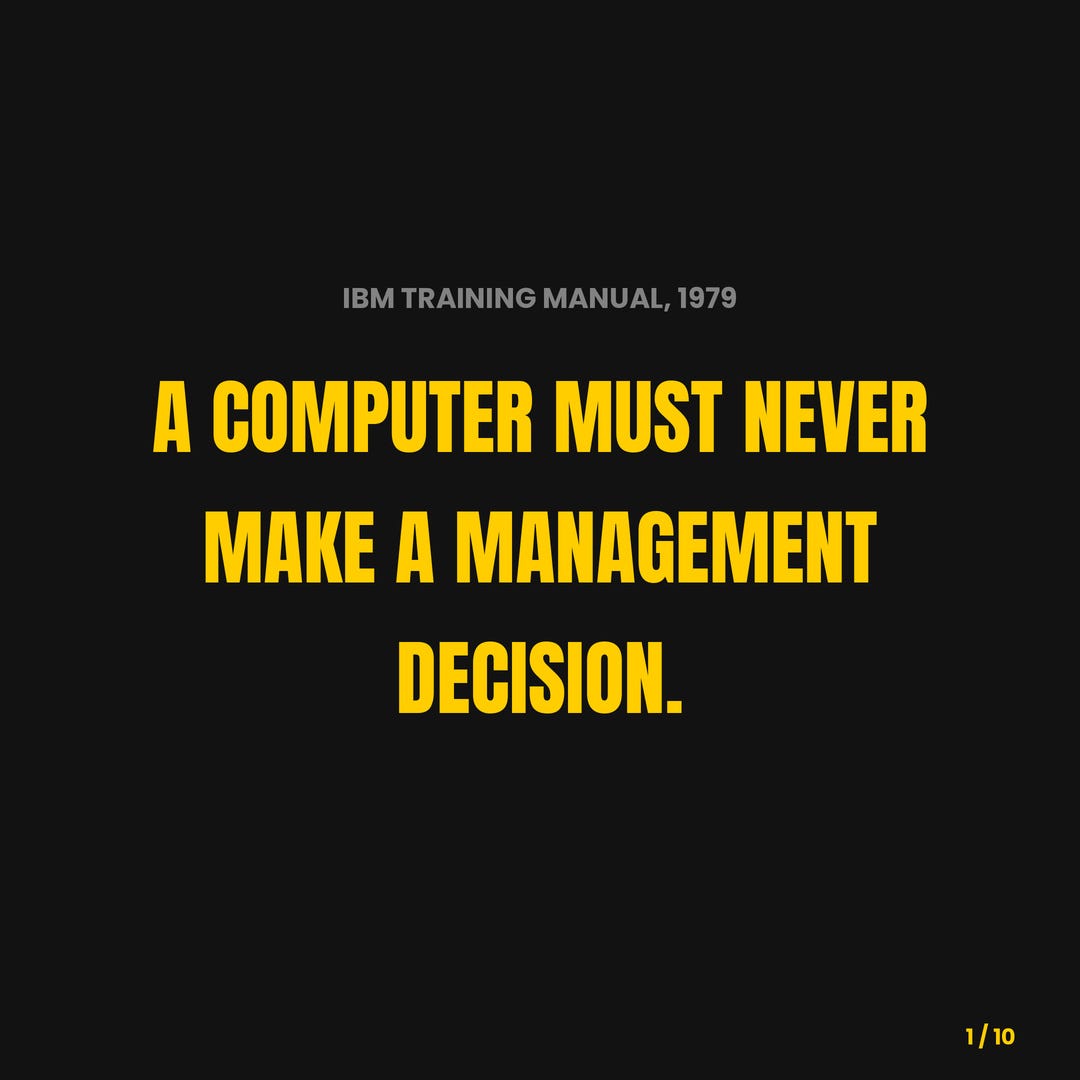

“A computer can never be held accountable, therefore a computer must never make a management decision.”
IBM Training Manual, 1979
IBM wrote that sentence 47 years ago. At the time it was not a warning. It was a statement of fact so obvious it barely needed saying. Computers in 1979 were deterministic tools. They did exactly what they were programmed to do, nothing more and nothing less. If a computer produced a wrong answer, you traced the error back to the human who wrote the instruction that caused it. Accountability was built into the architecture.
I came across this quote recently in an IBM article on AI decision-making, and it stopped me the way a sentence stops you when it is simultaneously completely right and pointing at something that has quietly slipped away.
Because the principle IBM stated in 1979 is more important now than it was then. And far harder to maintain.
What has changed
Three things broke the 1979 assumption, and they broke it in ways that make the accountability question genuinely difficult rather than merely bureaucratically complicated.
The first is opacity. Large language models and neural networks do not make decisions through traceable rules. They produce outputs through statistical patterns learned from training data, and those patterns are not fully legible even to the engineers who built the systems. When a modern AI system makes a consequential call, there is often no decision tree to audit, no rule to point to, no instruction written by a human that you can trace the output back to. The machine reasoned its way to an answer through a process its creator cannot fully explain.
The second is scale and speed. AI systems now make millions of consequential decisions per second, at volumes no human workforce could supervise in real time. The emerging generation of agentic AI systems takes multi-step autonomous actions, browsing, writing, executing, transacting, without requiring human approval at each step. IBM’s 1979 statement assumed a human would remain in the loop for each decision. That assumption has been quietly retired as a business efficiency measure.
The third is diffused accountability. When a Tesla operating in full self-driving mode struck and killed a motorcyclist in April 2024, the question of who bears responsibility immediately fractured. The driver, who had looked away from the road. The company, whose algorithm failed to detect the victim. The regulator, whose testing may not have been rigorous enough. The developers, who allowed the code to operate in conditions it was not equipped to handle. As one analyst quoted in the IBM piece put it: shared accountability often leads to no accountability.
What has not changed
The core logic of the IBM statement has not changed at all. And understanding why makes the current situation clearer.
IBM was not making a technical claim in 1979. They were making a moral one. A computer cannot be held accountable because accountability requires the capacity for judgment, the ability to weigh competing considerations, to reason about what ought to be done rather than merely what is most efficient, and to bear the consequences of being wrong. Computers, deterministic or statistical, do not have that capacity. They optimize. They do not decide in the morally meaningful sense of the word.
Which means the human who relies on the computer’s output without exercising independent judgment has not eliminated the need for accountability. They have simply created a gap between where the decision was made and where the responsibility lives. And that gap is where things go wrong.
The more powerful the tool, the more critical it is that a human remains the accountable party. That is exactly backwards from how we tend to think about capability. We assume that a more capable AI reduces the burden on the human. In terms of labor, it does. In terms of accountability, it increases it, because the consequences of an unexamined output are now larger and faster and harder to reverse.
The individual version of the same problem
The IBM article frames this as an enterprise question, and it is. But there is an individual version of the same problem that I think about more, because it operates below the level of policy and governance.
At the organizational level the question is: who is accountable when AI gets it wrong?
At the individual level the question is: who is thinking when AI generates the answer?
Both questions reduce to the same principle. The machine cannot own the outcome. Which means the human must own the decision that preceded it. If the human skipped the decision by accepting the output without applying their own judgment to it, the accountability is hollow. Not legally, necessarily. But practically, and in a way that compounds over time.
A professional who accepts AI outputs without verifying them is building a career on a foundation they cannot defend when the foundation is challenged. We have seen this play out in courtrooms already, with lawyers submitting AI-invented case citations they had not checked, discovered only because the judge happened to know the cases did not exist. The problem was not the AI. The problem was the human who accepted the output as a substitute for judgment rather than as a starting point for it.
At scale, across millions of people making this same substitution across millions of daily decisions, the aggregate effect is a population that is increasingly fluent at using tools that reason and increasingly unpracticed at reasoning themselves. The IBM training manual identified the governance problem in 1979. The cognitive problem it implies is what I wrote a book about.
Where the line needs to be
The IBM article identifies three considerations for where organizations should draw the line on AI decision-making: ethics, risk, and trust. The analyst quoted suggests AI is well suited to risk quantification but cannot navigate ethical dilemmas, and that trust requires human transparency about how AI is being used.
I would add a fourth consideration, one that applies at the individual level as much as the organizational one: judgment.
Not every decision requires deep ethical reasoning. But every consequential decision requires someone who can tell the difference between an answer that is correct and an answer that is merely confident. That distinction requires judgment. And judgment is a capacity that atrophies when it goes unused.
This is why I think the IBM quote from 1979 matters more now than it did then. Not because the rule has changed, but because the temptation to violate it has never been greater. AI produces fluent, polished, confident outputs with zero friction. Accepting those outputs without examination feels efficient. It is efficient. The cost is paid later, in the gap between the answer the machine generated and the decision the human was supposed to make.
IBM saw the principle clearly 47 years ago. We are just now learning how hard it is to hold.
The machine generates. The thinker decides.
The Amplified Mind publishes August 2026. This is the eighth post in Notes from The Amplified Mind.
Paul