
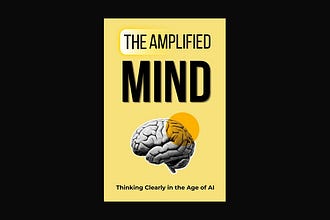

I want to share something I came across this week, because it connects directly to why I wrote The Amplified Mind, and because I think it matters for a group of people I have not spoken to directly yet: students, and the teachers and professors shaping how they think about AI right now.
What I found
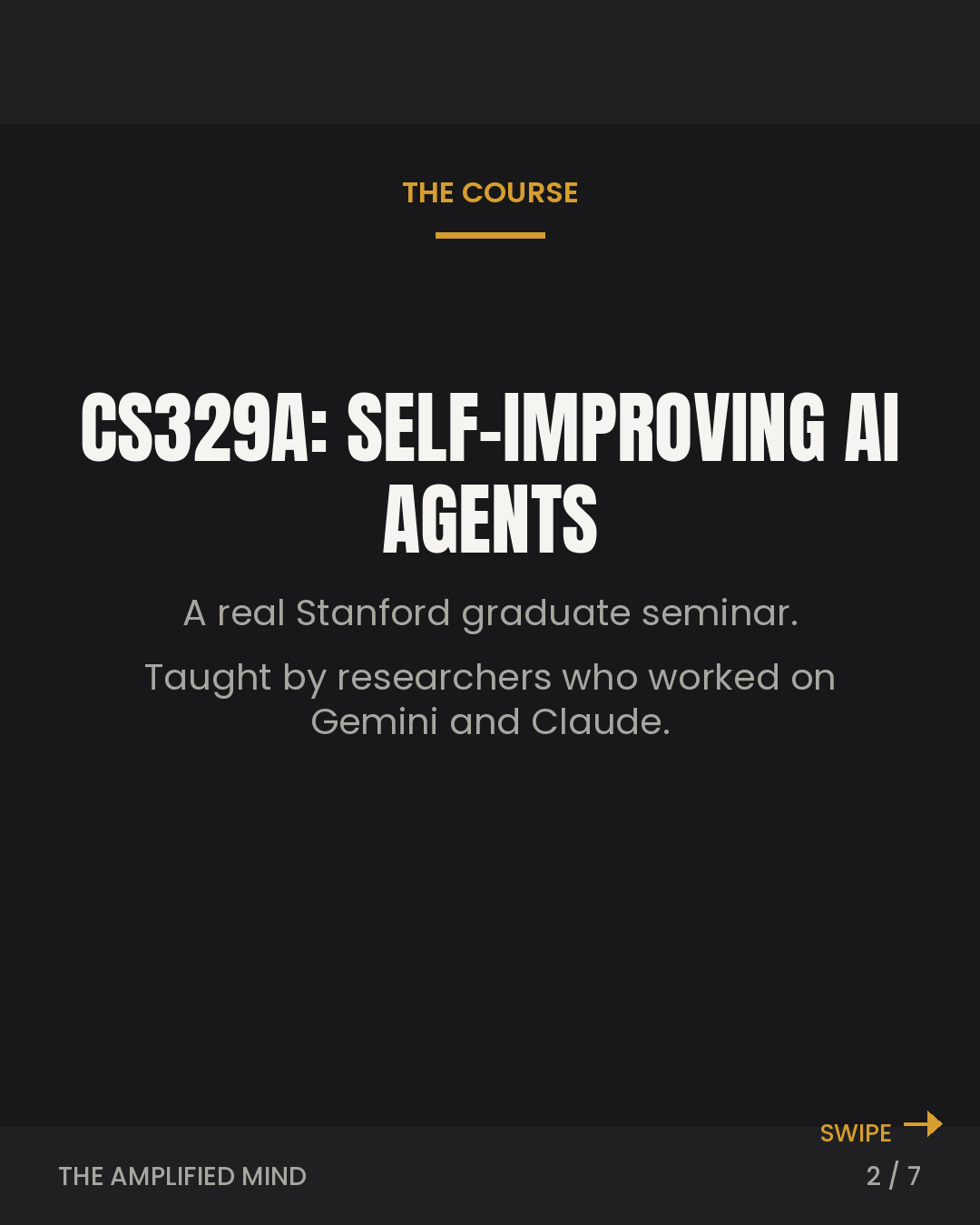
Stanford’s Computer Science department offers a graduate seminar called CS329A, Self-Improving AI Agents. It is taught by researchers with direct experience building Gemini and Claude. This is not a YouTube series or a blog claiming Stanford affiliation. It is listed in Stanford’s official Bulletin, School of Engineering, with its own course website.
The official course description covers self-improvement techniques for large language models. That includes constitutional AI, domain-specific verifiers, test-time compute scaling, tool use, multi-step reasoning, and what the course calls robust evaluation and orchestration frameworks.
Strip away the academic language, and here is what that means in practice. A significant part of this course is dedicated to one unsolved problem. How do you verify that an AI’s output is actually sound, when the system generating it cannot be fully trusted to check its own work.
Why I care about this
I spent 38 years as a firefighter and EMT. In that job, verification is not academic. You check the gauge. You confirm the address. You verify vitals before you act, because acting on a wrong assumption costs something real. That instinct followed me into everything I have done since, including how I think about AI.
I wrote an entire book around the gap between what AI generates and what a person actually verifies before acting on it. Not for AI researchers. For everyone else. Business owners, professionals, parents, students, anyone using AI tools to make real decisions in their work or their lives.
I called it the verification gap. The idea is simple, even if the implications are not. AI can generate an answer in seconds. It can sound confident, polished, even authoritative. But generation is not the same as truth. Someone still has to decide whether the output is actually correct, and that someone has to be a human being who kept their own thinking sharp enough to catch it when the machine gets it wrong.
That is the whole thesis behind the line I use throughout the book. The machine generates. The thinker decides.
What Stanford’s course confirms
What strikes me is that Stanford is validating this from the opposite direction. I wrote about the verification gap as a personal and professional discipline, something anyone can build regardless of technical background. Stanford’s course treats the same gap as an unsolved technical research problem, at the infrastructure level, among people building the actual models.
Same gap. Two different altitudes. If the people building these systems are still fighting to solve verification at the architecture level, that should tell you something about how much scrutiny the rest of us need to bring to what AI hands us every day. This is not a fringe concern or a talking point. It is, by Stanford’s own framing, one of the central open problems in the field right now.
The machine generates. The thinker decides. That is not a slogan. It is becoming the design constraint the entire industry is building around.
An appeal, if you know someone in school
Here is the part I actually want to ask you to act on.
If you have a kid in high school or college right now, or you teach one, or you know a professor wrestling with how to handle AI in the classroom, this is the exact gap they need to understand before it understands them.
Students are the group leaning on AI the hardest right now, and often the least equipped to catch it when it is confidently wrong. A high schooler drafting a college essay, a freshman writing a first research paper, a grad student running literature reviews through a model, none of them are being taught the discipline of verification as a skill. Most are being handed the tools with no framework at all.
That is exactly the gap I built the book, and a companion course, to close. I put together a page specifically for educators, built around teaching this as a habit of mind, not a set of rules to memorize: The Am
If a name came to mind while you were reading this, a student, a teacher, a professor, send them this piece. Not because I need the traffic. Because this is a genuinely useful thing for someone standing at the start of their thinking life to hear early, from someone who has spent real time on both sides of the problem, the fire ground and the page.
The Amplified Mind: Thinking Clearly in the Age of AI is available now on Amazon.