

The August 2026 cover of The Atlantic carries a headline that stopped me mid-sentence: “The End of Reading Is Here.” The article, by staff writer Rose Horowitch, is eight thousand words of reported argument that the literate era may be a brief historical anomaly, sandwiched between oral culture and what she calls postliterate culture. I read every word. Then I went back and read it again.
Not because it confirmed my fears. Because it confirmed my book.
The numbers Horowitch assembles are striking on their own. According to the National Endowment for the Arts, fewer than half of American adults reported having read a book of any kind in 2022. A study of 236,000 respondents to the American Time Use Survey found that the proportion of Americans reading for pleasure on any given day fell from 28 percent in 2004 to 16 percent in 2023. And here is the one that stayed with me: gambling is now a more common leisure activity than reading a book, with 57 percent of Americans placing a bet last year.
But the reading decline is only half the story. What Horowitch is really describing is a decline in the kind of thinking that reading produces. UCLA cognitive neuroscientist Maryanne Wolf argues that people are losing not the ability to decode individual words, but what Wolf calls the higher-order abilities of comprehension and synthesis. America, Horowitch writes, is not illiterate. It is postliterate. The distinction matters enormously.
And then there is the paragraph on artificial intelligence, which arrives near the end of the piece and lands like the real point of everything that came before it.
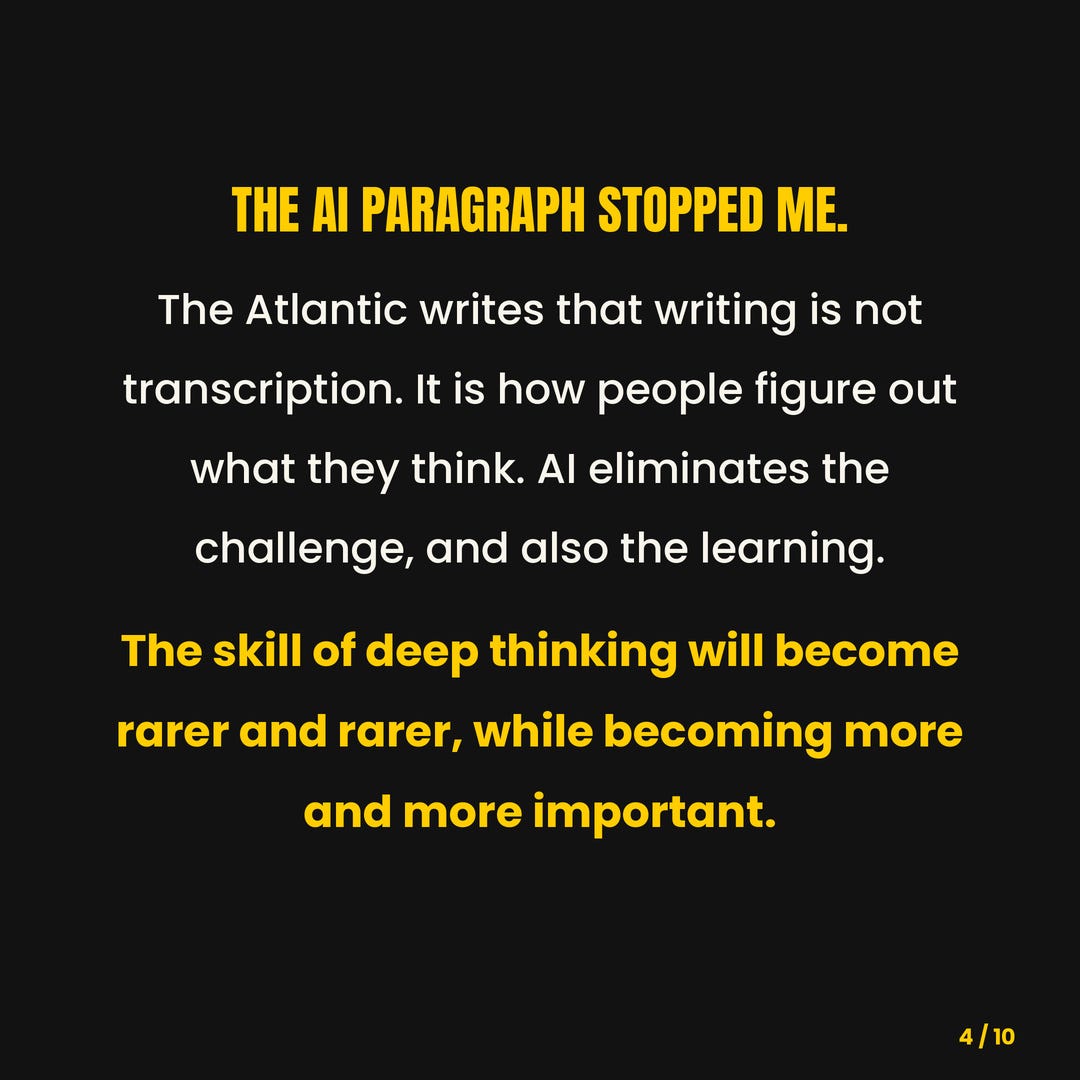
Horowitch argues that writing is not the act of transcribing fully formed thoughts. It is how people figure out what they think, and how to convey those thoughts to someone who does not already share them. Georgetown computer science professor Cal Newport, whom I cite in my own book, is quoted arguing that the process of writing forces people to think in an orderly, linear fashion. It exposes flabby thoughts and shoddy reasoning. AI eliminates that friction, and with it, the learning.
I want to be careful here, because it is a point worth stating precisely. My book cites Newport’s Deep Work at length, and in a specific way. Deep Work identified the enemy of focused thinking as distraction: email notifications, social media, the fragmented attention economy. The discipline Newport prescribes, protecting long blocks of uninterrupted concentration, was the right answer to that environment.
But AI introduces a different kind of problem, and it is one that Deep Work’s framework does not fully address. The interruption AI provides is not frivolous. The system’s responses are useful. When a mind reaches for an AI tool, the result is often genuinely helpful reasoning: suggestions, counterarguments, structured explanations. That is precisely what makes it more dangerous than a notification, because it is harder to resist and easier to mistake for thinking.
The Atlantic piece includes a line from NYU philosopher Kwame Anthony Appiah that I think is the most important sentence in the article. If people become overreliant on AI to write for them, he argues, they could lose the capacity to interrogate or even develop their own views. If we gave those up, he writes, we would stop being the kind of humans that we are. We would be very different creatures.
That is the whole thesis of my book in one sentence from a philosopher I did not know to quote when I was writing it.
The Atlantic also notes that the skill of deep thinking will become rarer and rarer while becoming more and more important. This is the exact dynamic that The Amplified Mind is built around. Not a ban on AI tools, and not a romantic defense of effort for its own sake, but a practical framework for keeping the step that matters: deciding for yourself, before you accept what the machine has generated.
Leah Price, a historian of reading at Rutgers University, tells Horowitch that reading has become a niche hobby, like stamp collecting or growing orchids. I understand why she says it. But I also notice that just 20 percent of adults account for more than 80 percent of all books read. That 20 percent are not a rump. They are the people who will shape how the rest of society thinks, reasons, and decides, especially as AI makes the appearance of thinking easier to manufacture and harder to distinguish from the real thing.
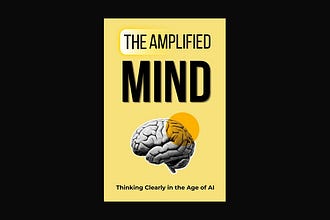
The Amplified Mind arrives August 2026. If you are reading this, you are probably in that 20 percent. This is a book for you, and for everyone you are trying to keep there.
The machine generates. The thinker decides.
This is part of Notes from The Amplified Mind, a series running in the months before the book comes out.