

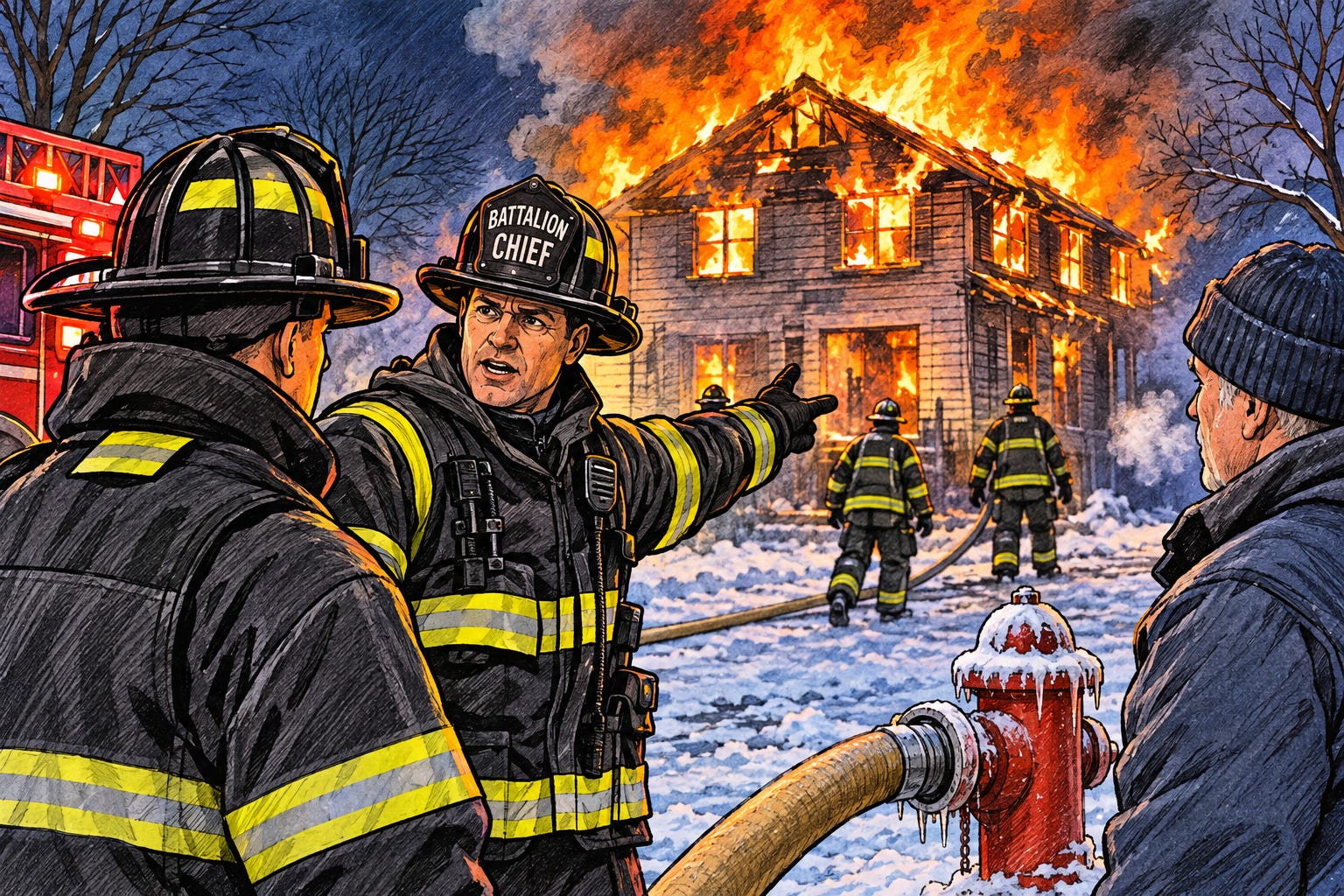
We were the first engine on scene a little after midnight on New Year’s Eve. The cold had already settled into the street. The house was a two-story single-family home, fully engulfed, with fire through the roof on the bedroom side and the windows on that floor gone.
I got off the rig and did what I’d been trained to do: a 360 before anything else. My walkaround of the perimeter told me little beyond the driveway. No garage. No cars. For a house with a family in it, that stood out.
A neighbor was standing at the end of his walk, watching. I asked him whether there are usually cars in that driveway when people are home. He said if there aren’t any cars, they probably aren’t home. Then he added that he’d seen the family pull out earlier in the evening, and he was pretty sure they were out celebrating.
I had the origin pegged to the bedroom area and the conditions in front of me. It was 12 degrees with a brutally cold wind, and the fire was well advanced. I believed nobody could survive that in a room like that. I also knew my crew was going to want to go in.
So I made the call. Given everything I observed, we would not commit to an interior attack. We would start with an exterior knockdown and, more importantly, establish a water supply. The hydrant closest to the house was frozen, so we had to pull a supply from one farther away. That took additional time and resources, and it was time we couldn’t spare. A fire this size on a night this cold would reach the houses next door unless we got water on it fast and kept the exposures wet.
My crew was not happy. They said it out loud, and I could see it on their faces when I announced our strategy. We were trained to go in, and every one of them had reason to believe someone might be inside. I didn’t argue with them. I told them what I had: no cars, a neighbor who saw the family leave, and an origin I didn’t believe anyone could have lived through. I told them the decision was mine.
When additional apparatus arrived, we did a quick interior sweep. No one was home. That confirmed what I’d decided, but it didn’t change what I knew when I made the call.
Later, the Battalion Chief questioned the decision before he had read my report. I understood why. From the outside, a house with a fire like that looks like a building you go into. He read the report from start to finish. The reasoning was in writing: the driveway, the neighbor’s account, the origin, the exposure risk, the frozen hydrant and the longer supply line, the cold. When he finished, he told me:
"I wanted to understand your decision, and now I do. You assessed the conditions, gathered the information available to you, considered the risks to your crew and the surrounding homes, and made a decision based on what you knew at the time. You documented your reasoning, and you're prepared to stand behind it. That's what I expect from an officer. I may not always agree with every decision, but I expect every decision to have a defensible rationale. You own the decision, and I'll own supporting you when you've exercised sound judgment."
I was relieved. Not because I’d been proven right, but because the call had been checked and it held.
What the Decision Owed
Accountability is a simple structure, whether you’re on an apparatus or in an office. The person who decides answers for it, and the record is written so someone else can check the reasoning. None of that depends on the outcome. A sound call can turn out badly, and a poor call can turn out fine. The job is to be able to explain the call either way.
Fire departments learned this the hard way. After-action reviews exist because a department that punishes people for honest mistakes gets silence, and silence hides the problems that will hurt the next crew. The reviews that work ask what the officer knew, what they decided, and what the system should change. They separate the quality of the decision from the luck of the result. That separation is the most useful idea I took from thirty-eight years in the service.
Accountability in Ordinary Life
The same pattern shows up everywhere, usually in smaller moments.
A manager who has to lay off a team member can either explain the reasons plainly, with the criteria written down, or hide behind “restructuring” and “business needs.” The first builds trust even when the news is bad. The second teaches everyone that nobody owns the decision.
A parent who gets a call from a teacher about their child’s behavior has a similar choice. Defending the kid by default or dismissing the teacher’s concern both avoid the real question: what do we know, and what do we do next? Ownership means asking that question before deciding who is at fault.
A contractor who finishes a job without the permits, or a doctor who orders a test without documenting why, is making a decision and then hoping the paperwork never gets read. Accountability is what happens when someone does read it, and the answer holds up.
The common thread is the record. People who explain their decisions in writing, at the time they make them, are rarely caught off guard later.
Accountability in the Public Sector
Public institutions face the same test at a larger scale. A police department that reviews a use-of-force incident, a hospital that investigates a death, or a school district that explains a policy change is doing the same thing a fire officer does after a call: asking what was known, what was decided, and whether the reasoning holds.
The difference between honest review and performative review is usually visible in the paperwork. An honest review names the decision-maker, lays out the information available at the time, and identifies what the system should change. A performative review names a scapegoat, rewrites the timeline, and closes the file. Citizens can tell the difference, and once they can’t trust the record, every later decision gets harder to defend, including the good ones.
Accountability in Politics
“Accountability” is now one of the most-used words in public life, and one of the least precisely applied. Almost everyone invokes it, almost always about someone else. Each side describes the other’s failures as a lack of accountability, and each side’s own failures as someone else’s fault.
The word loses its meaning when it becomes a weapon. A standard only means something if it applies evenly. That means asking the same questions of every party and every institution: what did you know when you acted, what did you decide, what did you document, and are you willing to submit that record to review? The answers will differ, and they should be judged on their facts. The standard itself should not change depending on who is in power.
I’m not suggesting that every political disagreement is a question of accountability. Many are about values, and those should be argued openly. But when a claim of failure is made, the same test should apply regardless of who is making it or who is being accused.
Accountability and AI
We are now being handed tools that produce confident answers: a diagnosis, a legal summary, a memo, a probability of survival. The output looks finished, and that’s the danger. It’s tempting to treat the tool as the decision-maker, and when the result is wrong, the tool becomes the convenient place to put the blame.
Consider a plausible example. An office manager uses an AI assistant to summarize a benefits policy for employees. The summary omits an eligibility requirement, and several employees make decisions based on it. When the error surfaces, the first explanation offered is “the AI summarized it.” That explanation doesn’t hold. The manager chose to send the summary without checking it against the source document. The tool drafted the text; the manager decided it was ready.
Ownership doesn’t transfer to the software. If you send the memo, you own its claims. If you act on the probability, you own the choice. Just as a gas meter’s alarm doesn’t decide whether a crew evacuates, a thermal camera’s reading doesn’t decide whether a crew advances a line, and “the AI wrote it” doesn’t decide whether a memo goes out. The device flags the condition. The person in charge decides what to do about it, and answers for that decision.
A Practical Framework
Before you send anything an AI helped you produce, or act on an answer it gave you, ask three questions:
What did I know when I made this call? Separate what you verified from what the tool told you.
What would I need to show someone who checks it? If you can’t point to the source, the reasoning isn’t ready.
Am I willing to be the one who answers for it if it’s wrong?
If you can answer all three, the tool helped you think. If you can’t, the tool is deciding for you.
Judge the Decision by What You Knew
The fire scene is a small example of a large principle. The decision should be judged by what was known when it was made, and the person who made it should be ready to explain it. That standard applies to the captain, the manager, the parent, the official, and the person typing a prompt into a machine.
Accountability doesn’t guarantee good outcomes. It guarantees that someone can answer the question, “why did you do that?” In a time of confident machines and loud arguments, that is worth more than it used to be.
Paul Alden is a retired fire captain and EMT with 38 years at the Plymouth Fire Department. He is the author of The Amplified Mind: Thinking Clearly in the Age of AI.