

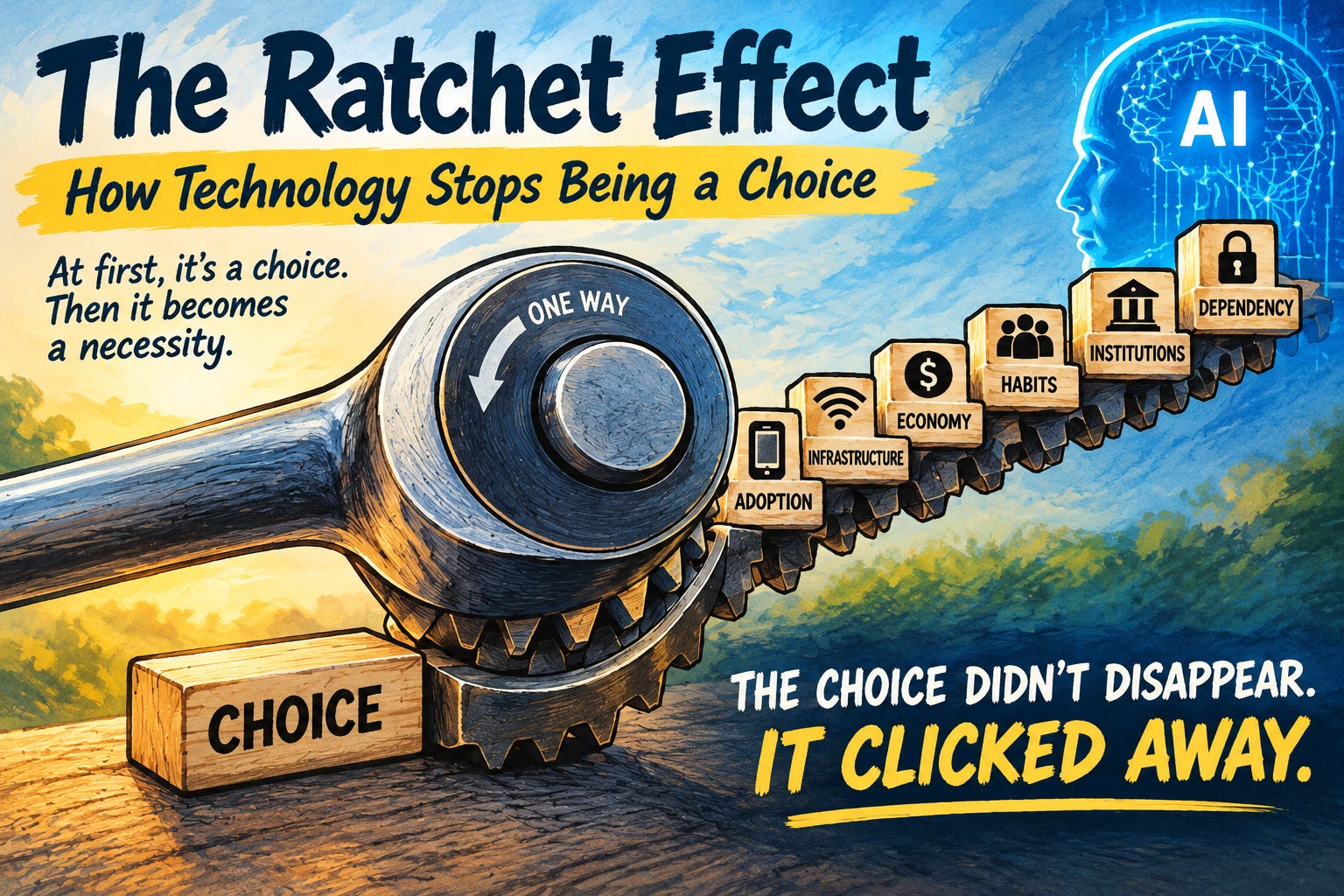
There’s a moment in every major technological shift when adoption becomes dependency. You don’t see it happening. Nobody announces it. One day you’re choosing to use something; the next day, not using it would cost more than you’re willing to pay. The choice didn’t vanish overnight. It clicked away, one notch at a time.
Economists and systems researchers have a name for this. They call it the ratchet effect. It mostly lives in academic papers. It’s time to talk about it plainly, because we’re living through it right now.
A ratchet turns freely in one direction. Reversing it requires deliberately releasing the mechanism. Society almost never makes that effort in time. We adopt something widely enough that the infrastructure, the economy, the habits, and the expectations all reconfigure around it. Then going back isn’t just inconvenient. It’s catastrophically disruptive. So we don’t go back. We call it progress and keep turning the wheel.
The academic case is solid. It just never left the ivory tower.
Economists have studied this for decades under the label of path dependency, the idea that early choices constrain later options in ways that compound over time. The QWERTY keyboard layout is the textbook example, and its real history is even better than the myth.
Most people believe it was designed to slow typists down to prevent key jams. That’s largely false. The actual story involves telegraph operators who found alphabetical keyboards useless for translating Morse code, mechanical engineers separating letter pairs that caused typebars to collide, and Remington’s sales team tweaking the final layout to get around competitors’ patents. Nobody sat down and designed QWERTY for the world we live in now. It accumulated its shape through a series of unrelated decisions, got commercialized by the right company at the right moment, and became the standard. A hundred and fifty years later, we’re still using it. Not because it’s optimal. Because switching costs grew larger than the benefit of switching.
That’s the ratchet. No conspiracy. No master plan. Just a series of locally rational decisions that compounded into something nobody would have chosen on purpose.
Political theorist Langdon Winner captured the deeper pattern in his 1980 essay “Do Artifacts Have Politics?” Technologies aren’t neutral tools, he argued. They embed values and expectations that persist long after the original choice is forgotten. The technology shapes behavior. The behavior shapes institutions. The institutions resist change. What began as a decision calcifies into an assumption. By the time anyone thinks to question it, it has become the water everyone is swimming in.
That’s the harder version of the ratchet problem. It’s not just that reversal becomes too costly. It’s that the original choice eventually stops being visible as a choice at all.
Smartphones are the case study everyone lived through.
Think back to 2007. The iPhone launched. You could buy one or not. That was a real choice. By 2015, not having a smartphone meant opting out of social invitations, business workflows, banking apps, navigation, and two-factor authentication. By 2020, the pandemic-era infrastructure assumed everyone had one. Today, the phrase “I don’t have a smartphone” requires explanation in a way that “I don’t have a landline” does not.
The ratchet clicked.
The cultural, economic, and social architecture rebuilt itself around the device. Schools send alerts to apps. Medical systems use patient portals. Banks require mobile authentication. None of that was a coordinated plan. It was millions of individual decisions by institutions and individuals, each rational in isolation, collectively eliminating an alternative.
Nobody voted on this. Nobody announced that smartphone ownership would become a de facto requirement for full participation in modern life. The ratchet doesn’t require a conspiracy. It just requires adoption to reach a certain density, and then the momentum takes over.
Could society have reversed it? Technically, yes. The release mechanism was always there. But reversing a ratchet requires coordinated, conscious effort at a scale that almost never materializes, and by the time most people recognized what had happened, the cost of reversal had grown larger than anyone was willing to pay.
We are mid-click right now with AI.
The window is still open, but it’s narrowing. Right now, AI assistance is optional in most professional contexts. You can choose not to use it for writing, analysis, customer service, research, or code. That choice costs you something in efficiency, but it’s a real choice.
That window will close. The colleagues who use AI will produce more. The organizations that deploy it will outcompete the ones that don’t. The infrastructure will rebuild around the capability. At some point, “I don’t use AI tools” will sound the way “I don’t use email” sounded in 2005: technically possible, practically disqualifying.
That’s not speculation. That’s the ratchet, and it’s already turning.
But here’s where AI is different from every technology that came before it, and why this particular click deserves more attention than most.
Smartphones changed how we communicate and navigate. They reshaped attention, shortened solitude, and made us reachable in ways we didn’t fully consent to. Those were real losses, and we traded them without quite realizing it. The click was quiet, the loss was gradual, and most people concluded the trade was worth it.
AI has the potential to change something more fundamental: how we think. Not just what we produce or how fast we move, but how we reason, evaluate, weigh evidence, and arrive at conclusions. If the ratchet clicks on a tool that shapes cognition itself, what atrophies on the other side isn’t attention or solitude. It’s judgment. And judgment, unlike a navigation app or a messaging platform, is not something you can turn back on when you need it if you’ve spent years not using it.
That’s the question worth sitting with. Not whether AI is good or bad. Whether we’re walking into the click with our eyes open.
What clear thinking looks like in this moment.
I’m not arguing for resistance. The ratchet doesn’t care about resistance. I’m arguing for clarity.
If you’re going to integrate AI into your work and your thinking, do it consciously. Understand what the tool does well and what it substitutes for. Know the difference between augmenting your judgment and outsourcing it. Pay attention to what atrophies when you stop using it. Stay on the right side of that line.
The choice isn’t really “AI or no AI.” That window may already be closing. The real choice, the one that’s still open, is what kind of user you become.
Amplified or replaced. Thinking with the machine or letting it think for you.
The ratchet is mid-turn. Most people haven’t noticed. That’s exactly what the ratchet is counting on.
Paul Alden is a retired Fire Captain, author of The Amplified Mind: Thinking Clearly in the Age of AI (Alive Book Publishing), and founder of Amplified Mind Media LLC. His book explores how to remain a clear, sovereign thinker in a world where AI is reshaping how we work, learn, and reason.