

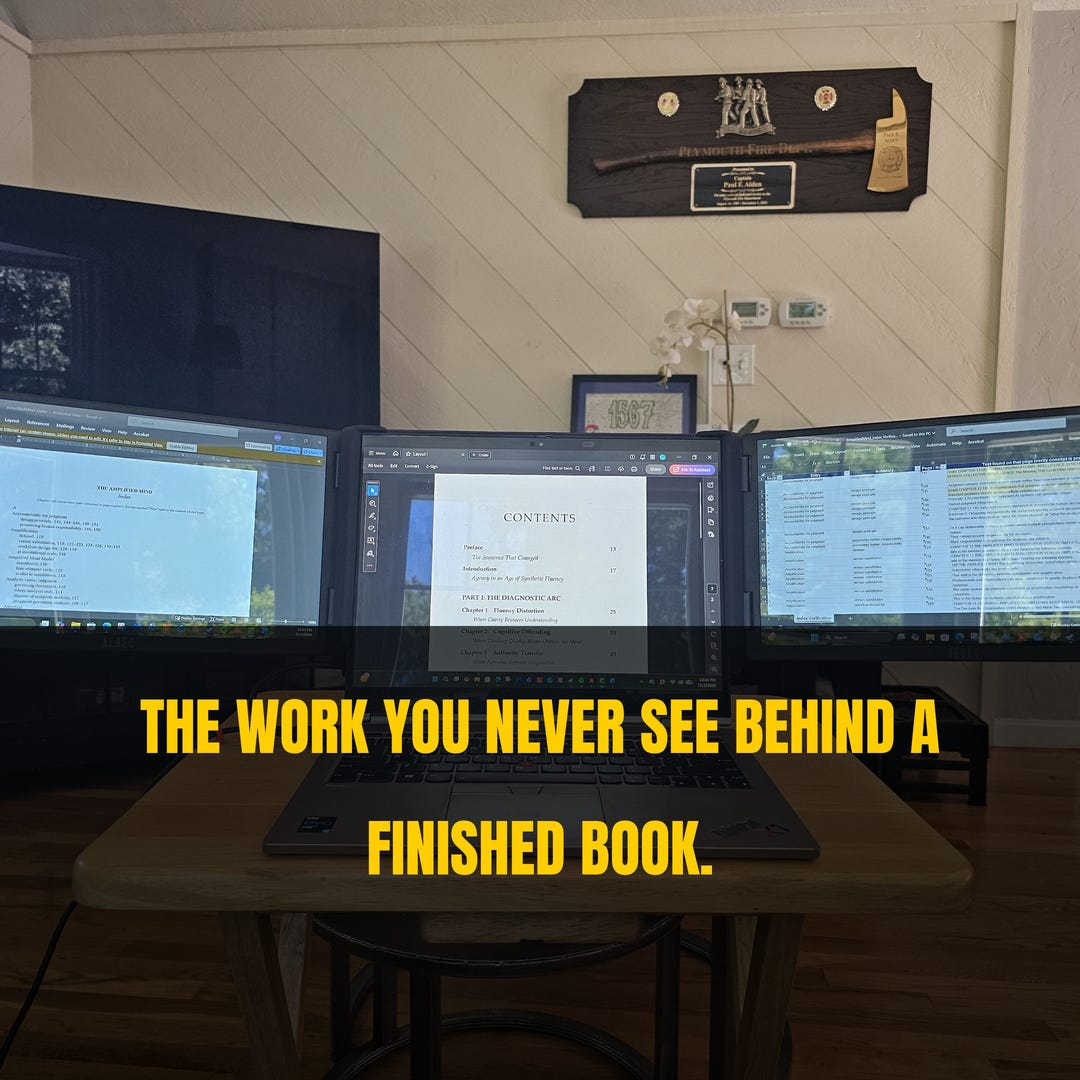
I took a photo of my desk yesterday and almost did not post it.
Three screens, a tangle of cables, a laptop on a wooden stool, and a Plymouth Fire Department plaque on the wall behind it all. Not staged. Not lit. Just the actual setup I have been working at for the past several days as I finished one of the most painstaking parts of publishing a book.
The index.
Most readers never think about the index. They use it occasionally, maybe to check if a name or concept they half-remember actually appears in the book. But building it is a different thing entirely. It requires reading every page of the manuscript with a specific kind of attention: not for meaning this time, not for flow or argument, but for precision. Every topic. Every concept. Every proper name. Verified against every page reference it carries.
For a book about the discipline of thinking clearly, there was something fitting about that.
Where the book stands today
As of this week, here is where The Amplified Mind stands.
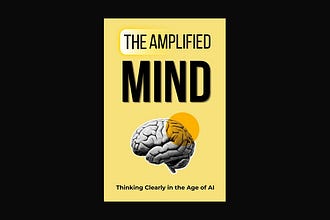
The front cover is complete. If you have been following along, you have seen it. The yellow background, the halftone brain, the title in heavy black type. What I hope it communicates is that this is not a book about AI in the abstract. It is a book about what happens inside a mind when it interacts with a tool that generates ideas faster than it can evaluate them.
The back cover is complete. The back carries the argument in compressed form: every tool in human history waited for us to think first. AI does not. It generates the idea itself, fluently and without friction. That fluency is the danger. The back cover closes with the line that has become the book’s spine: The machine generates. The thinker decides.
The interior layout is complete. The typesetter, Eric at Alive Book Publishing, has been patient and precise through multiple proof cycles. The chapter structure is clean. The endnotes are in order. The design serves the argument rather than decorating it.
The index is complete. Six pages. 1,234 words. Every entry verified by hand against the page it references. The index note reads: this index was compiled utilizing AI, and verified by the Author. That disclaimer matters to me. I used the tool. I did not outsource the judgment.
The index as a case study in the book’s own argument
There is a line in Chapter 2 of The Amplified Mind about cognitive offloading. When we hand a task to a tool, we are not simply saving time. We are also deciding which mental capabilities we are willing to let atrophy. The question the book asks is not whether to use AI. The question is what you are giving up when you let it think for you, and whether that is a trade you are making deliberately.
Building the index gave me a concrete version of that question.
I used AI to generate an initial draft of the index. It was fast, structurally sensible, and wrong in specific places that only a close reading would catch. A reference attributed to page 110 that actually landed on page 112. A subentry that existed in a chapter draft but had been cut in editing. A concept indexed under a term I used early in the book but had deliberately replaced with a more precise one by the final chapter.
None of those errors were large. Each one would have made the index less trustworthy in a way that a reader might not notice until they went looking for something and found nothing there. Or found the wrong thing.
So I verified every entry. Not because I distrust the tool, but because verification is the step that makes me the author of this index rather than the editor of one. That distinction matters to me. The tool amplified my capacity to build the index. The judgment about what belonged in it remained mine.
That is the whole argument of the book in several afternoon’s work.
What happens next
The manuscript goes back to the publisher this week for what is called a single-run proof edition. A physical copy of the book, printed once, that I will hold in my hands and review as a final check before approving it for release.
This is the last gate. Once I sign off on the proof, the book goes to print.
I have been in this process long enough to know that there is always something. A widow line on page 47. A page number that dropped from the header. A footnote that ran long and pushed a paragraph onto the next page in a way that breaks the rhythm. You cannot see these things on a screen. You have to hold the book.
In the fire service, we called the last walkthrough before releasing a scene the final size-up. You did not clear a structure until someone had physically been through every room with fresh eyes, regardless of how confident you felt about the initial assessment. The proof copy is my final size-up.
The plaque on the wall
I did not plan for the Plymouth Fire Department plaque to be in that photo. It is just there, on the wall behind my desk, where it has been since I retired.
But I kept the photo because of it.
Thirty-eight years in the fire service. Every one of them required a version of the same discipline this book is about: reading a scene carefully before acting on it, checking your assumptions against what is actually in front of you, and refusing to let a confident first impression substitute for a thorough assessment. The fire service did not teach me to distrust my tools. It taught me that the tool and the person using it are not the same thing, and that the difference between them is where all the accountability lives.
That is what I wanted to write about. It took me a long time to realize I already knew it. I just had not applied it to a machine that generates ideas.
Coming in August
The Amplified Mind publishes in August 2026 through Alive Book Publishing.
The next update I send you from this process will be a photo of the proof copy in my hands. After that, the book will exist in the world, and the conversation can begin in earnest.
Thank you for reading along. This series has been its own kind of thinking out loud, and I am grateful for the company.
The machine generates. The thinker decides.
Paul
l