


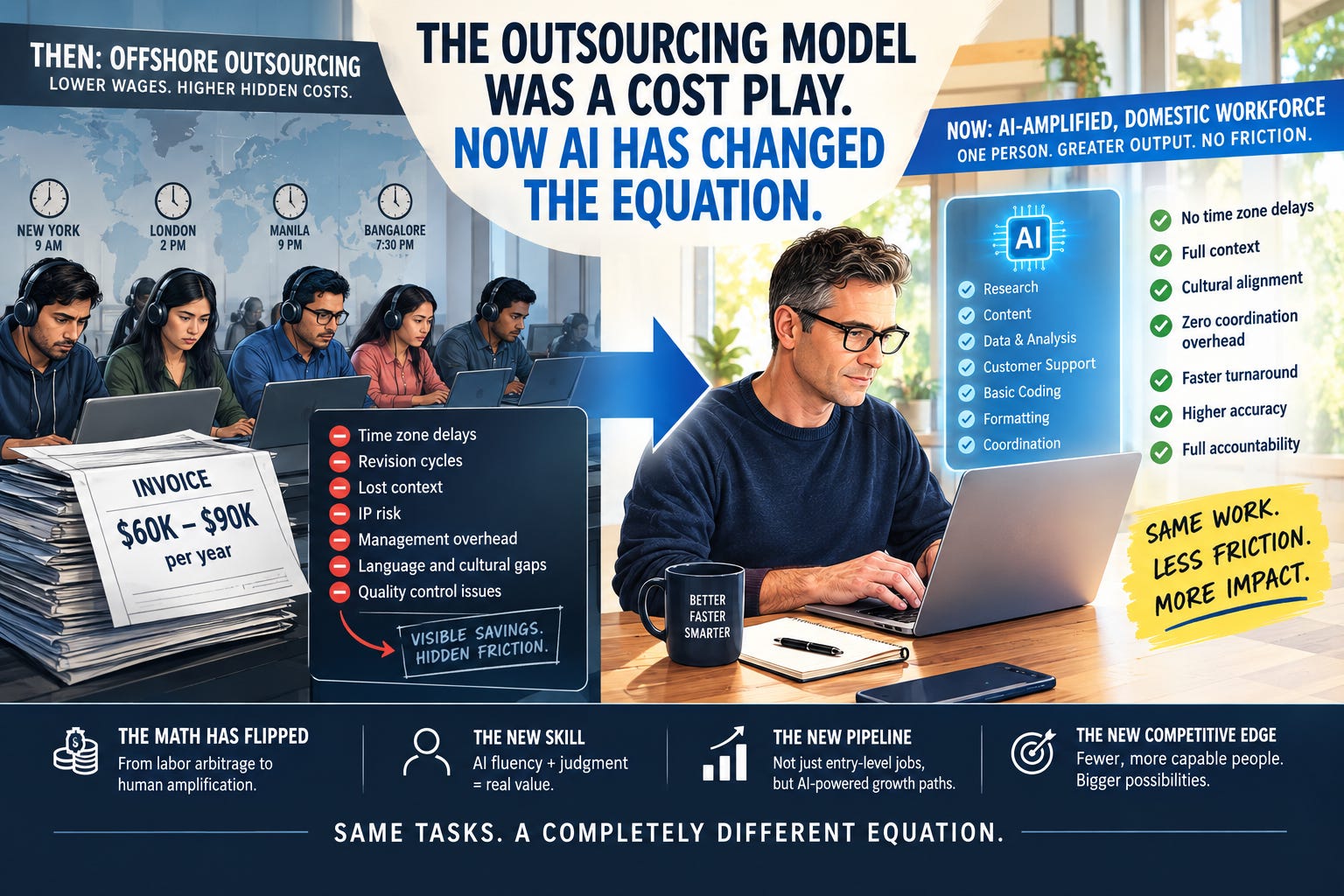
For three decades, the outsourcing model was treated as settled economics. Why pay a domestic worker $55,000 a year to handle data entry, customer support, content production, or basic research when you could pay a fraction of that to a team overseas? The math seemed obvious. The logic seemed unassailable.
It wasn’t.
AI has just changed the equation entirely, and most companies haven’t noticed yet.
The Arbitrage That Wasn’t What It Looked Like
Outsourcing was sold as a simple cost play. But anyone who has managed an outsourced workflow knows the real ledger looks nothing like the invoice.
There’s the time zone tax. The revision cycles. The lost context every time a project changes hands. The intellectual property risk when your business logic lives on servers you don’t control. The management overhead required to coordinate across language barriers and cultural frameworks. The quality control layer you have to build just to catch what falls through the cracks.
The offshore model didn’t eliminate labor costs. It traded visible labor costs for invisible friction costs. Companies got comfortable with the arrangement because the friction was diffuse and hard to quantify, while the invoice savings were easy to point to in a budget meeting.
AI is making that friction visible by eliminating it altogether.
The Flip
Here is the core insight worth sitting with: the jobs that were most attractive to outsource were the entry-level, high-volume, repeatable tasks. Data processing. Content drafts. Research summaries. Customer-facing correspondence. Basic coding. Formatting. Coordination.
Those are precisely the jobs that AI handles most effectively.
The offshore model exploited the gap between what those tasks cost to do domestically versus abroad. AI closes that gap from the other direction entirely. It doesn’t lower the wage. It multiplies the output of the person being paid.
One AI-fluent worker in the same time zone, with full context, full cultural alignment, and full accountability, can now produce the output of a small offshore team. Not because the technology is magic, but because the friction is gone. There is no handoff delay. No interpretation gap. No revision email chain. No meeting to re-explain what was already explained.
The work flows.
What “AI-Fluent” Actually Means
This is where the conversation usually goes sideways. People hear “AI can replace outsourced workers” and they imagine a button that does the work automatically. That’s not what’s happening.
What’s happening is more interesting, and more demanding.
An AI-fluent worker isn’t someone who handed their job to a chatbot. They’re someone who understands how to use AI as a precision tool, when to trust its output, when to question it, how to prompt for what they actually need, and how to layer their own judgment on top of what the machine produces.
That last part matters more than most people realize. AI generates fluently. It does not judge wisely. The person holding the tool still has to know what good looks like, what the client actually needs, what the company’s voice is, and when the output is technically correct but strategically wrong.
The machine generates. The thinker decides.
That’s not a slogan. It’s the actual job description of the AI-fluent worker. And it is a skill set, not a given. The people who develop it are becoming genuinely difficult to replace at any price point.
The Entry-Level Paradox
There’s a harder edge to this conversation that deserves honesty.
Outsourcing didn’t just shift jobs overseas. It gutted the entry-level domestic pipeline. Those first jobs, tedious as they were, were also where people learned. They were the rungs on the ladder. Show up, do the volume work, absorb how the business operates, build judgment through repetition, earn your way up.
That pipeline is broken in a different way now. AI handles the volume work, which means the rung looks different. You can’t earn your judgment by doing a thousand data entry tasks if AI does them automatically. The learning path has to be redesigned from the ground up.
The companies and workers who figure that out early will have a significant advantage. The ones who assume AI-fluency is a trait people just acquire on their own will find themselves with a workforce that knows how to operate the tool but not how to think behind it.
This is not a small problem. It’s a structural one. And it’s worth far more attention than it’s currently getting.
The New Math
Let’s do the rough arithmetic, with the caveat that real numbers vary by industry and role. [Speculation: illustrative comparison only.]
An outsourced team of five handling content, research, customer support, and basic data tasks might run $60,000 to $90,000 annually when you account for management overhead, rework costs, quality control, and coordination tools. Output is solid on routine tasks but drops on anything requiring contextual judgment or speed of iteration.
One AI-fluent domestic worker, paid at a fair market rate, using current AI tooling, can now handle comparable or greater volume on those same task types, with better contextual accuracy, faster turnaround, full time zone alignment, and zero coordination overhead.
The math has flipped. Not everywhere, not for every role. But at the entry-to-mid tier where most outsourcing was concentrated? The case for offshore is eroding quickly.
This Is a Re-Shoring Story, Just Not the One You Expected
The political conversation about re-shoring focuses on factories, supply chains, and manufacturing. That’s real and important. But there’s a quieter re-shoring happening in knowledge work, and it’s being driven not by policy or tariffs but by tools.
The individual is back in play.
Not the individual as a cog in a large corporate machine, and not the individual as a freelancer racing to the bottom on a gig platform. The individual as a genuinely capable, fully amplified professional who can operate at a level that used to require a team.
That’s a different kind of economic story. It doesn’t fit cleanly on a campaign poster, but it’s unfolding in real time in offices and home studios and coffee shops everywhere that people have figured out that the tool, used well, changes what one person can actually accomplish.
What This Means for Companies Still Running the Old Playbook
If your competitive advantage has been built on labor cost arbitrage, you are now competing against individuals who have no arbitrage to offer but don’t need it.
The person who knows how to use AI well is not cheaper than your offshore team. They’re more capable, faster to iterate, easier to manage, and fully accountable for the output in a way that a distributed offshore workflow simply cannot replicate.
The race to the bottom just got lapped by the race to the top.
Companies that see this early will restructure their workflows around fewer, more capable people with real AI fluency. Companies that don’t will keep optimizing a model that the market is quietly rendering obsolete.
The script has flipped. The only question is who reads it first.