

Every adult alive built critical thinking the same way. Through friction.
The failed drafts. The arguments you lost. The answers you had to dig for because no one handed them to you. It felt like the work was getting in the way of the learning. It wasn’t. The struggle was the learning. That resistance, the effort of holding a hard problem in your head until it gave way, is where the skill actually forms.
AI removes the friction. You ask, and a confident, fluent answer appears in seconds. No struggle, no dead ends, nothing to push against. For someone who already built the skill, that is a convenience. For a mind still forming it, there is nothing left to build on.
This is not a hunch. It is starting to show up in the research.
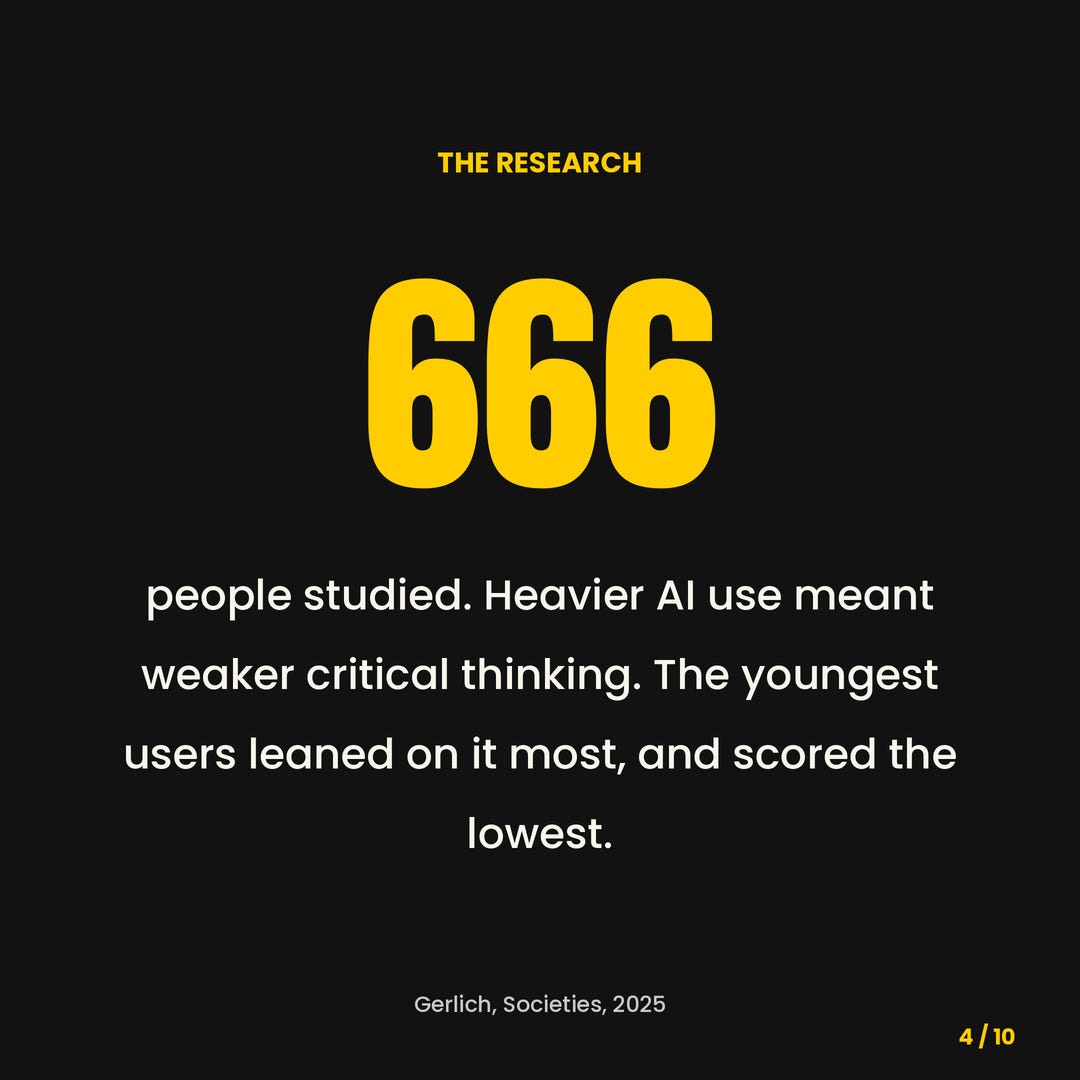
In a study of 666 people, published in the journal Societies in 2025, heavier use of AI tools tracked with weaker critical thinking, an effect the author linked to cognitive offloading, the habit of letting a device carry the mental load. The youngest participants were the most dependent on the tools and scored the lowest. It is correlational, so it shows an association rather than proof of cause, but the direction is hard to ignore.
A brain-imaging study out of the MIT Media Lab in 2025 put a finer point on it. Writers using an AI assistant showed the weakest brain connectivity of any group in the study, and many could not accurately quote the work they had just produced. The researchers called it cognitive debt. It is a preprint, not yet peer reviewed, and even the lead author has pushed back on the more breathless “brain rot” headlines. But the picture it paints is sobering: the less your brain does, the less it seems to engage.
And it is not only about accuracy. A 2024 study in Science Advances found that AI can make an individual’s writing more creative while making everyone’s writing more alike. Lift one person up, flatten the group. Fluency without friction does not just dull your thinking. It can quietly homogenize it.
You do not have to go to a lab to see the shape of the problem. Look at the lawyers. Across more than 1,400 documented court cases now, attorneys have filed legal citations that AI simply invented, rulings that never existed. A judge who actually knows the law spots the fabrication in seconds. The lawyer who trusted the fluent answer cannot, because they never built, or never used, the judgment to check it. That is the whole risk in miniature. The tool produced something polished and wrong, and the human had outsourced the one job that mattered.
Here is the part I want to be careful about, because it is easy to overstate. None of this proves that a generation raised on AI will be unable to think. It is a risk, drawn from what the data already shows about today’s youngest users and from everything we know about how skills are built. But it is a risk worth taking seriously now, while these habits are still forming, rather than after.
The answer is not to ban the tool. It is to keep the friction on purpose. Do the hard part yourself first, then let the machine help. Question what it gives you. Verify it. Decide for yourself. That is a choice you can make every single day, and it is the difference between a tool that sharpens your thinking and one that quietly stands in for it.
The machine generates. The thinker decides.
This is part of Notes from The Amplified Mind, a series I am running in the months before the book comes out. The Amplified Mind arrives August 2026
.