
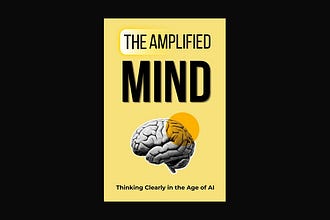

The title of my book raises a question I didn’t fully appreciate until someone asked it directly.
What exactly is being amplified?
There’s a meaningful difference between the brain and the mind. Most people use the words as though they mean the same thing. They don’t.
The brain is the physical organ. Neurons, synapses, electrochemical signals. It processes, stores, retrieves. Measurable biology. A sophisticated machine, but still a machine.
The mind is the subjective apparatus built on top of that biology. Judgment. Reasoning. Awareness. Discernment. The capacity to evaluate, question, and choose. It’s what we mean when we say someone thinks well, not just thinks fast.
Here is where AI enters the picture in a way that should give us pause.
AI amplifies brain-like functions without question. It extends memory, speeds retrieval, accelerates pattern recognition, offloads calculation. These are real gains. Useful gains.
But my book is about what happens beneath that utility.
When AI handles the mechanical work of thinking, the mind gets less exercise. Judgment atrophies when it goes unexercised. Framing shapes our conclusions before reasoning even begins. Passive acceptance quietly replaces active evaluation. We get the output, but we skip the process that builds the capacity.
So here is the honest answer to the question hiding in my title. AI amplifies the brain. My book is about protecting the mind.
The word “amplified” works on two levels. It can mean enhanced. But amplification also carries another connotation: signal boosted without discrimination. Amplifiers don’t filter. They turn everything up, including noise. Including distortion.
That ambiguity is the whole point. Are you using AI to think more clearly? Or are you gradually outsourcing the very capacity that makes clear thinking possible?
My new book, The Amplified Mind: Thinking Clearly in the Age of AI, is available now on Amazon at amazon.com/dp/1631322850